 |
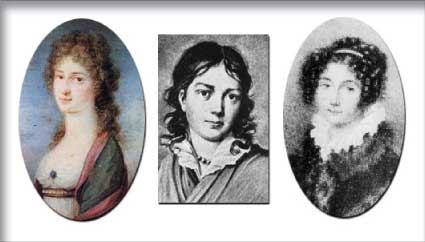
Beethoven's Famous Letter to his "Immortal Beloved"The German original of Beethoven's 1812 letter to the woman he called his "Immortal Beloved" is found as no. 582 in Sieghard Brandenburg's edition (volume 2, pp. 268-72). In Emily Anderson's 1961 edition, the letter is no. 373 (vol. 1, pp. 373-376). Because Anderson's translation is not literal, the American scholar Virginia Beahrs created a new very accurate English translation in 1990. It was published in The Beethoven Newsletter (which later became The Beethoven Journal), vol. 5, no. 2 (pp. 29, 34-39). Her article contains a page-by-page translation of the 10-page letter and supplies extensive footnotes on the exact wording of the original and how those words have become part of the clues to the identity of the woman. Today, three women are considered to be the most likely candidates (in alphabetical order!): Antonie Brentano (above left), Bettina Brentano (above middle), and Josephine von Brunswick (above right). Each theory has strengths and weaknesses. The Antonie Brentano theory was proposed by the American scholar Maynard Solomon in an essay that later became a chapter in his biography, Beethoven (New York: Schirmer, 1977, rev. 2001). The Bettina Brentano theory is proposed by the Canadian scholar Ted Walden in a forthcoming book. An article containing his arguments was published as "Beethoven's 'Immortal Beloved': Arguments in Support of the Candidacy of Bettina Brentano"The Beethoven Journal, vol. 17, no. 2 (2002): 54-68. The Josephine von Brunswick theory has been proposed by several scholars: the German Harry Goldschmidt, the German scholar Marie-Elisabeth Tellenbach, and the Canadian scholar Rita Steblin. A condensed version of the argument is found in Tellenbach's "Beethoven and the Countess Joséphine Brunswick, 1799-1821," The Beethoven Newsletter, vol. 2, no. 3 (Winter 1987): 41-51. |