 |
|
The Many Faces of Beethoven
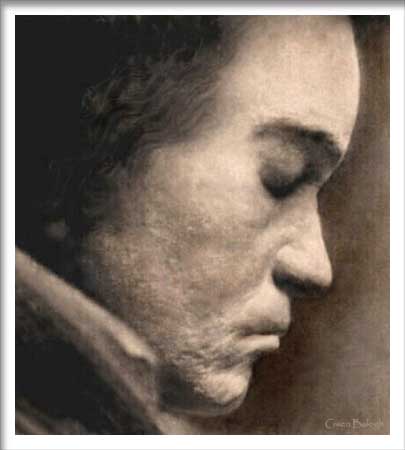
Because Beethoven died before photography was invented by Louis-Jacques-Mandé Daguerre (1787-1851) in the 1830s, there is only one accurate record of his face. In 1812 the artist Franz Klein made a plaster life mask of the composer in preparation for a bust of the composer that had been commissioned by the fortepiano-building family Nanette and Andreas Streicher. It is considered by scholars to be "the truest representation of the composer's facial features." Although it does not capture his eyes (which were covered with cotton balls), his nostrils, or his ears, the startlingly accurate mask caught every pore in Beethoven's skin and the shape of his face and mouth. Because it was the only reliable record of what Beethoven looked like after the composer died, many artists have based their paintings and drawings of Beethoven on the life mask . (A death mask was taken after Beethoven died in 1827 by Joséf Danhauser, but it was made after a severe five-month illness and a gruesome autopsy). One of the members of the American Beethoven Society, Gwen Balogh, recently created a composite image of Beethoven that resembles what he would have looked like if photography had been invented in 1812. She fused a photo of the life mask with a drawing, blending the two together in a remarkably lifelike manner. Although it seems strange to people who do not love Beethoven and his music, Beethoven lovers feel very strongly about depictions of the composer in drawings, paintings, busts, and statues. We've collected several realistic and fanciful images of the composer in this section. Schroeder is far from alone in his passion for his Beethoven bust! |